Ocean Surfer Dash
Review
Ocean Surfer Dash succeeds by keeping its design simple and focused. The controls feel immediate, and the gradual speed increase creates a natural difficulty curve that never feels unfair. Visuals are bright and clear, making obstacle avoidance straightforward even at higher speeds. The lack of levels or unlockables keeps the experience pure, though some players may wish for more variety. For quick, satisfying sessions that test reflexes without demanding a large time investment, this game delivers exactly what it promises.
About
Core Gameplay Loop
Ocean Surfer Dash centers on a single, clear objective: navigate a surfer through an endless stretch of ocean while avoiding hazards. The game uses a vertical control scheme, where players move the character up or down to steer around obstacles that appear ahead. Speed increases gradually, demanding sharper timing and more precise movements as the session continues. Each run ends when the surfer collides with an obstacle, and the distance traveled becomes the player's score. This simple loop creates a compelling rhythm of short attempts and incremental improvement.
Control Scheme and Responsiveness
The controls are designed for immediate accessibility. On touchscreen devices, players swipe upward or downward to adjust the surfer's position. Keyboard users can use the up and down arrow keys for the same effect. Inputs register quickly, with no noticeable delay between a command and the on-screen action. This responsiveness is critical because the game's increasing pace leaves little room for lag. The control system does not require any calibration or customization, so players can jump into a round without adjusting settings.
Visual Presentation and Atmosphere
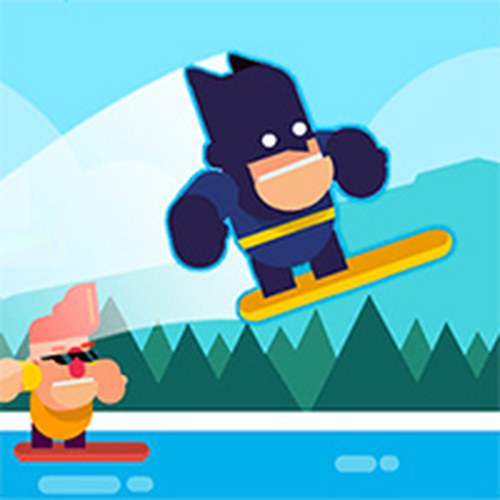
The game employs bright, colorful graphics that evoke a sunny beach environment. Water textures ripple and shift as the surfer moves, and obstacles are clearly silhouetted against the backdrop. The color palette stays vibrant throughout, helping players spot upcoming hazards even as speed picks up. Animations are smooth, with the surfer leaning into turns and reacting to wave movements. This visual clarity supports the gameplay by ensuring that obstacles remain easy to distinguish from the background, reducing confusion during fast sequences.
Difficulty Progression and Replay Value
Ocean Surfer Dash does not use levels or checkpoints. Instead, difficulty scales continuously based on how long a run lasts. Early segments move at a moderate pace, giving newcomers time to learn obstacle patterns and control sensitivity. As the run extends, the game introduces faster obstacle sequences and tighter gaps. This gradual ramp-up means that each new personal best requires sharper focus than the last. Because there is no fixed endpoint, players can always attempt to beat their previous distance, which encourages repeated play without introducing new mechanics or content.
Session Length and Accessibility
Individual rounds in Ocean Surfer Dash are brief, typically lasting between thirty seconds and a few minutes. This short session length makes the game suitable for quick breaks or casual play between other activities. There are no tutorials, menus, or configuration screens to navigate before starting. The game launches directly into action, with a single tap or key press beginning a new run. This design removes barriers to entry, allowing players of any age or experience level to participate without prior instruction.
Comments
Sign in to leave a note
You must be logged in before posting a review or rating.
No account? Create one
No comments yet. Be the first to comment!